I check and double check the front door. Keys in hand. Backpack dangles from one shoulder. Morning paper clenched between my teeth. Nicole, my nine-year-old daughter, waits by the car holding my coffee mug. I unlock the car. Climb in. Throw my backpack on the back seat and register the reassuring click of the seatbelt. I pause and behold this daily, un-extraordinary ritual, and I see that it is good enough. No veils darkening the sky. No Beast crushing my chest. Perhaps last night was a false alarm.
Nicole hops in the front seat beside me and puts my mug on the dashboard. “Mom, open your mouth.” She tugs the Miami Herald free and flips it open.
“The Hutus and Tutsis are still killing each other,” she says.
I glance over and look straight into the wide-set eyes and smooth brown forehead of a Rwandan child with his right cheek and ear bandaged. I yank the paper from her and toss it face down on the dashboard.
“Why can’t I see it?” Nicole asks.
“Because I don’t want you to see horrible things like that.” I adjust the rearview mirror.
“Why?”
“Because I don’t want you worrying about stuff you can’t do anything about.” I start the engine.
“Dad says you worry too much.”
“Did you put on your seatbelt?”
Nicki points to the shoulder strap secured in place. I loathe nine-year-olds.
I back out of the driveway and drive the two blocks to the bus stop, slowing down for each yellow speedbump and keeping an eye on my coffee. We’re early so I pull over on the grass to wait with a half dozen other cars. Turning to Nicole, I smooth out the dark brown bangs on her forehead.
“Has Mamita ever told you the story about Maria la Buena?” Mamita is my Cuban grandmother.
Nicki musses her bangs. “Nope, never heard it. Is it a little kid story?”
“Not really.” I sip my coffee. Tepid. I put the mug back on the dashboard. This too has happened before, but today even this annoyance is blessed.
“Well, once upon a time there was a very good and very sweet girl called Maria la Buena who lived deep in the forest with her twin sister, Maria la Mala. Whenever Maria la Buena opened her mouth, pearls, diamonds, rubies and sapphires fell from her red lips and landed in sparkling heaps by her pink satin slippers.”
“Was she beautiful?” Nicole sucks on a slim strand of hair.
“As beautiful as a pair of white shoes before the first scuff, or a perfectly yellow banana, and she never, ever, put her hair in her mouth.”
“That’s not how the story really goes.” Nicole looks away.
The morning sun flares off the rim of the mug, and I raise my hand to shade my eyes. Across the street there’s a little old man sitting on the bus bench and holding a cane. He’s wearing a white robe and his leather sandals dangle off his feet which don’t quite reach the ground. He’s bald with a wispy white moustache and goatee, and his dark aviator sunglasses reflect the sun so it looks like he has stars for eyes. What fairy tale did he crawl out of? As if he’s heard me, he looks up and smiles.
“Mom? The story?”
“Where was I?”
“Maria la Buena was beautiful like a banana.”
The little old man is still smiling.
“Mom?
“What?” I turn to Nicole.
“Maria la Buena? She’s still a banana?” Nicole checks herself in the little mirror on the back of the visor and puckers her lips.
“OK, right. Now her sister, Maria la Mala, was also very beautiful, and in fact, standing side by side, you couldn’t tell the two sisters apart. But Maria la Mala was wicked and cruel, and whenever she opened her mouth, spiders and slugs and roaches would crawl out and swarm all around her.” I wriggle my fingers in Nicole’s face, and flick the strand of hair out of her mouth.
She squeals. “That’s disgusting.”
“But true. So, one day a handsome prince was out hunting in the forest with a bunch of his lords and dukes. He was chasing a deer that kept leaping deeper and deeper into the forest until it finally leapt across a wide, rushing river and disappeared into the trees. The prince couldn’t follow because he was afraid of drowning himself and his horse.”
“What color is the horse?”
“Dark brown, like the wet hair that’s back in your mouth. So, before he knew it, the prince was lost. And as he rode his horse the color of wet dark brown hair looking for his lords and dukes, he came upon a little cottage which, of course, belonged to, ta da, the two Marias. As he approached the front door, it opened, and the loveliest girl he had ever seen was standing there. He said, ‘I am lost and seek shelter. What is your name, fair maiden?’ The girl parted her lips to speak and—here’s the bus.”
Nicole springs up. “Bye, Mom.” She hoists her book bag which nicks my mug. Milky coffee sloshes onto the dashboard and the newspaper.
“Fuck,” like papery wings escapes my lips.
Nicole slams the car door and dashes to the bus.
“Shit.” Nicole didn’t give me a kiss. I stab at the window control button and break a polished nail tip. “Shit.” Lower passenger window. “Shit, shit.” Finally lower my window and poke my head out. “Love you, baby.”
Nicole is about to enter the bus and swings around, eyes darting between me and the other kids waiting to get in behind her. She winks, steps inside, and joins a group of her girlfriends. They all wave to me as the bus pulls away.
OK. So, I don’t hate all nine-year-olds all of the time.
Across the street, the bus bench is empty. I bite off the broken nail and flick it out the window then wipe up the coffee with the sports section and toss what’s left in the mug out the window. I check in the visor mirror, dab on some red lipstick and pucker at my reflection. Looking out the window to pull onto the road, traffic is backed up.
“Fuck.” I’m going to be late for class.
Exhale. Put the car in gear. Keep moving.
I wait for a gap in the traffic as I suck on a strand of hair between my hastily painted lips.
§§§
I’ve been idling next to the same palm tree for what seems like ten minutes. I can see the flashing emergency lights off to the side just beyond my exit which must be the reason for the backup. The roadway before me resembles an enormous serpent with the shimmering, multihued scales of thousands of cars along its tensed coils. The sun’s heat and glare cause its paved spine to roil and slither as far as the eye can see. Like me, all these lurching cars, vie for a better position in the long, uninterrupted lanes of other cars. Each acceleration is a coveted conquest of space and time.
I pick up the front page and stare at the little Rwandan boy. It’s 1994 for God’s sake, almost the 21st century, and shit like this still goes on. Forget the slick promises of jet packs and travel to Mars if we can’t even get along on this planet.
My car dribbles forward.
This delay isn’t part of the plan. I will be late for class. There will be no seats left in the front, and I’ll end up sitting in the back with the slackers.
And what the hell am I doing going to school? A married mother of two spending three mornings a week taking classes on “The Literature of Evil” and “Continental Literature.” I should be saving Rwandan children.
That’s the not-Anna talking. No, not really. The not-Anna would say I should blow my fucking head off. This is a reality check not a cri de Coeur. Don’t get excited with false alarms.
I turn on the radio, and the measured tones of the public radio host—his rich, mellow voice the height of urbanity—reports the day’s headlines. Blood, sweat and semen spew forth through the airwaves as he relays the latest atrocities, both intimate and grand, and all of it only held back by the humming panels of the car speakers:
On April 11th an entire village of Tutsi men, women and children, many of whom had taken refuge in a church, were massacred by Hutu rebels using crude weapons, including machetes and spears, in their attacks. The United Nations estimates that between 100,000 to 200,000 Tutsis have perished at the hands of Hutu tribal militia since the initial outbreak of violence less than a week ago.
I think about that son-of-a-bitch, the one who argued against the existence of a tree which he could not hear falling from within the comfort of his ivory tower. The wonders of mass media would have certainly smacked his smug, contemplative puss into attention.
And me? Am I not just as sheltered from the problems of people whose screams I cannot hear across the world or even down the street?
“I’ve seen a lot of horrors as a relief-aid physician, but when you see a child with a machete wound on her…”
I turn off the radio. That’s someone’s child they’re talking about.
I remember Nicole’s face as she entered the bus, the way she pronounced the names in the headline like Dr. Seuss characters, not grasping the calamity of those silly sounding syllables. Nicole isn’t a third-world casualty but a third grader. Still I can’t help but feel sorry for her, for the world she’ll inherit, for the middle-class platitudes that will inform her, for the self-righteous mother with the mouth of an evil twin in a fairy tale.
“You mother-fucking bitch.”
I slam the brakes as an ox-blood convertible BMW cuts in front of me, top down, three young lovelies in bathing suit tops probably skipping class and headed to the beach.
I feel a surge of useless urban anger, and all I can do is pound the car horn and glare at the driver. She flips me a bird without even turning around to face me. I imagine her blonde hair bursting into flames, her makeup dripping off her face, the nail polish on her middle finger bubbling and melting, until she finally implodes, leaving a convenient vacuum that I can move my car forward in another space or two.
§§§
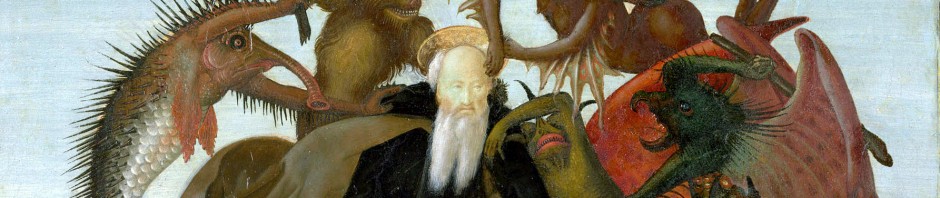
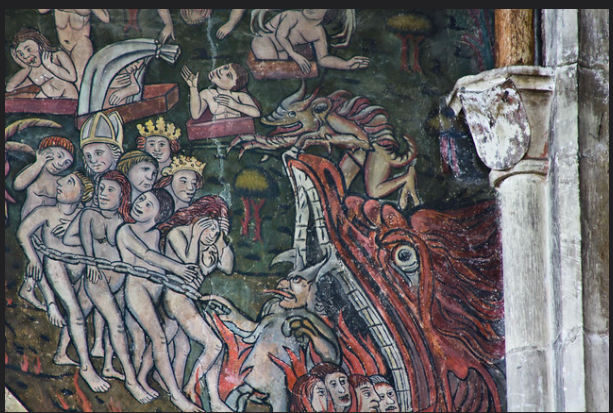
I arrive well into the lecture and make my way to the last row of desks under cover of darkness. The professor flips through slides of art depicting scenes of heaven and hell. Each image portrays good and evil in absolute terms of pleasure and pain, light and darkness. In one medieval triptych panel, an old man leads a naked woman with long brown tresses covering her naughty bits into the open maw of an enormous beast. She looks remarkably indifferent, her face expressionless even under the threat of eternal damnation. The old man—a serpent’s tongue darting through his teeth—leads her into the gates of Hell with the inscrutable mien of a meter maid writing out a citation. Their flat demeanors render the situation almost post-modern with disinterest. As the slide changes, I lean back against the wall, close my eyes and suck on a thin strand of hair.
Behind the scrim of my lids, I recreate the room, its lack of windows, the professor’s monotone namedropping of Bruegel and Bosch, Dante and Milton, the other students rustling papers, clicking their pens, and shifting in their seats. But my vision, like the figures in the panel, lacks emotion. I hover outside of myself in dispassionate observation as the veils descend upon me once more.
A Rotoscope overlay of long forgotten memories emerge, vivid and piercing and melancholy.
I am four years old. I’m straddling the chain link fence in my backyard, and my mutt, Happy, is nipping at my ankles. I have just realized that I am Anna, also known as Annie, and there is no one else in the world like me. I have divined God’s presence through the migrating clouds as I sit on the sun-warmed fence. God made me, and I exist as a reality apart from everything else. I’m about to ask God for a pony when I realize that no matter how hard I pray, I will never, ever get one. The sky darkens at this knowledge, but as part of some celestial recompense, I understand that I am somehow special, and the only difference now is that we both, God and I, know it.
I hadn’t remembered that moment for many, many years. Perhaps I didn’t have the language to put these feelings into precise words until now; my memories had long awaited the arrival of a vocabulary and syntax to give them life. But even back then, I was a little pisser.
Sally is a girl in my first grade class who throws up every day during math. The teacher’s solution to this problem is to sit Sally at a table by herself. I wonder about Sally’s home, does her mother yell a lot, does her father spank her, does her big brother twist her arm, or does she simply hate arithmetic? I’ve heard that Sally is something called Jewish. Maybe this is why she throws up. One day a group of children circle her in the playground. They call her a “Christ-killer,” joining hands in a clamoring show of solidarity and chanting it over and over, until the P.E. teacher scatters them, and they all run down the field to slaughter each other at dodge ball. Again the sky darkens as I watch Sally cry, and I am glad that I’m not Jewish.
I’m startled by the memory, long forgotten, yet more vivid than the room around me. Had I joined in with the other children? I can’t remember. Yet the flush I feel suggests my guilt, and I am awash with the cruelty of children. I have no further recollection of Sally, and I know this somehow deprives her of a happy ending, that she still stands alone in the playground, like a martyred St. Stephen tied to tree, abandoned by the other children, stranded in the passage of time.
I am eleven. I stay up late in bed watching Wuthering Heights on TV. At first I cry in an overwrought response to Heathcliff and Cathy’s doomed love. My emotions become more sweeping, spilling over into my desire to finally be a woman. I’m immersed in a maelstrom of a passion I have never experienced and feel the frenzy of a forbidden love. I sob into my pillow as my stuffed animals and Donny Osmond posters stare vacantly at the nascent stirrings of my puppy love run amok. The lighting in my pink room dims and the swirling plaster vault above darkens as I think about death, how I’d feel if someone I love, like Mamita, died. But I believe that love will somehow conquer death, and I pledge from this day forth to dedicate myself to finding my true love. I pull my nightgown collar down to reveal my bare shoulders, my pillow is my beloved, and I cling to my faceless lover.
The lights turn on and everyone gets up to leave the classroom. They stop to pick up their graded papers from the teacher.
I am thirteen and my breasts strain against my favorite old T-shirt. I struggle with awkward spurts of hormones that cause my monthly bloating and oily skin, the sour smells and sprouting hairs. These mark my long awaited womanhood, but they’re also somehow shameful and to be kept secret. But more confounding than the pull of nature to metamorphose the pupal innocence of my body is the conspiracy of approaching adulthood I detect in the subtle darkening of the sky one day. Never again will the firmament be the same shade of brilliant blue as it was before a green-eyed, fourteen-year-old boy kissed me behind the portables in the school yard, his mouth on mine causing a fluttering between my thighs like a caged bird dreaming of flight.


 Overture Curtain Lights